
 Share
Share


According to Iran’s official news agency, IRNA, the 10 Point Ceasefire Proposal (“Proposal”) included a demand that Iran maintain control of the Strait of Hormuz. On 4 April, an Iranian foreign minister stated that, pursuant to this demand, (a) vessels would be allowed safe passage through the Strait under Iranian military management for the next two weeks; and (b) Iran would be able to charge a fee of up to US$ 2 million per transit (ostensibly to fund reconstruction of damage caused by US and Israel air strikes).
Although the US government has stated that the Proposal may form the basis for further negotiations, Iran’s demand to maintain control of the Strait of Hormuz is likely to become a major sticking point.
On 9 April, again according to IRNA, the Iranian Revolutionary Guard Corps (“IRGC”) released a chart detailing a new traffic separation scheme either side of Larak Island and identifying a hazardous “danger area” to the south, suggesting (rightly or wrongly) that area may be mined.
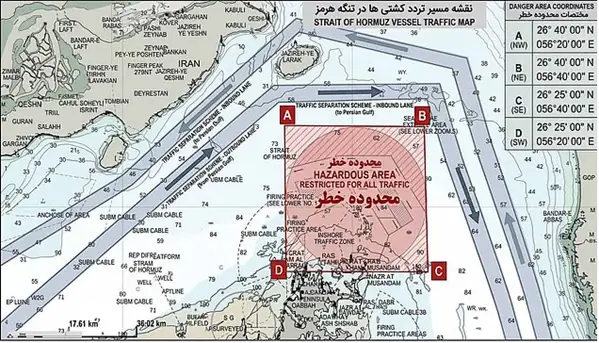
If this is true and if the new Iranian traffic separation scheme and toll are and remain the only way out of the Persian Gulf for those vessels/crew stuck there since 28 February 2026, then there are multiple implications, for all parties to the maritime adventure and their insurers. These relate primarily to sanctions but also concern whether and, if so, how the cost of such tolls might be defrayed by shipowners. There are no easy answers.
(If contrary to US pronouncements, the toll becomes the new “normal” and/or vessels currently waiting east of the Strait decide to transit west, then the tolls are a matter for shipowners and charterers to resolve, commercially, between themselves.)
It has been reported that tolls would be paid to and/or collected by the IRGC. The US has imposed extensive sanctions on the IRGC (designated by OFAC as an SDN and as a Foreign Terrorist Organization.) Accordingly, any toll paid to the IRGC or any of its members during the two week ceasefire now or thereafter would directly violate US sanctions.
Iran’s Proposal demands that the US government lifts all primary and secondary sanctions against it. The US government has maintained sanctions of varying levels through the Iranian Transactions and Sanctions Regulations, since the revolution in 1979.
The IRGC and various formations within it have been sanctioned/designated by the UK Government under the UK Iran (Sanctions) (Nuclear) (EU Exit) Regulations 2019 and the Iran (Sanctions) Regulations 2023.
President Trump has referenced offering “Tariff and Sanctions relief” as part of a negotiated agreement.
Even if the US ease sanctions, that does not mean the UK (or EU) will necessarily follow suit. There is no single global position. Further complications arise where the IRGC have been proscribed as a terrorist organization in many jurisdictions, albeit not in the UK.
Any sanctions hurdles will need to be overcome by shipowners in the first instance. If shipowners then seek to recover from other interests in general average or their insurers, complex coverage questions arise in addition to difficult legality issues. Those being asked to contribute will also have their own sanctions concerns (and contractual issues) to address.
Like so many aspects of this conflict, there is no guide or precedent (let alone certainty) on how these issues might be resolved. Whether the toll is described as a bribe, blackmail, unlawful, illegal or against public policy, it is a deeply unpalatable new development in waters previously free of such restrictions, not least as international waters under UNCLOS.
For vessels remaining in the Persian Gulf since 28 February, there is no parallel in modern times. The situation remains very fluid. But if it remains as it appears to be now, it is worth recalling the ransoms paid to Somali pirates (acting for private rather than state gain). As the English Court of Appeal observed in Masefield v Amlin [2011] “there is no universal morality against the payment of ransom, the act not of the aggressor but of the victim of piratical threats, performed in order to save property and the liberty or life of hostages. There is no evidence before the court of such payments being illegal anywhere in the world. This is despite the realisation that the payment of ransom, whatever it might achieve in terms of the rescue of hostages and property, itself encourages the incidence of piracy for the purposes of exacting more ransoms. (Perhaps it should be said that the pirates are not classified as terrorists. It may be that the position with regard to terrorists is different).”
 Insurance and reinsurance
 United Kingdom
 United States